
Transport Fever 3 cargo trams run freight on tram tracks into city centers. How they differ from light rail, where they fit, and what is still unconfirmed.
Transport Fever 3 Cargo Tram Guide: How Do Light Rail and Cargo Trams Work?
Quick answer: cargo trams are new freight vehicles that run on tram tracks, built to carry goods into city centers without noisy truck convoys. They configure like trains rather than classic street trams, and a separate light rail system covers longer fast passenger work. Exact capacities, costs, and track rules are still pending launch verification.
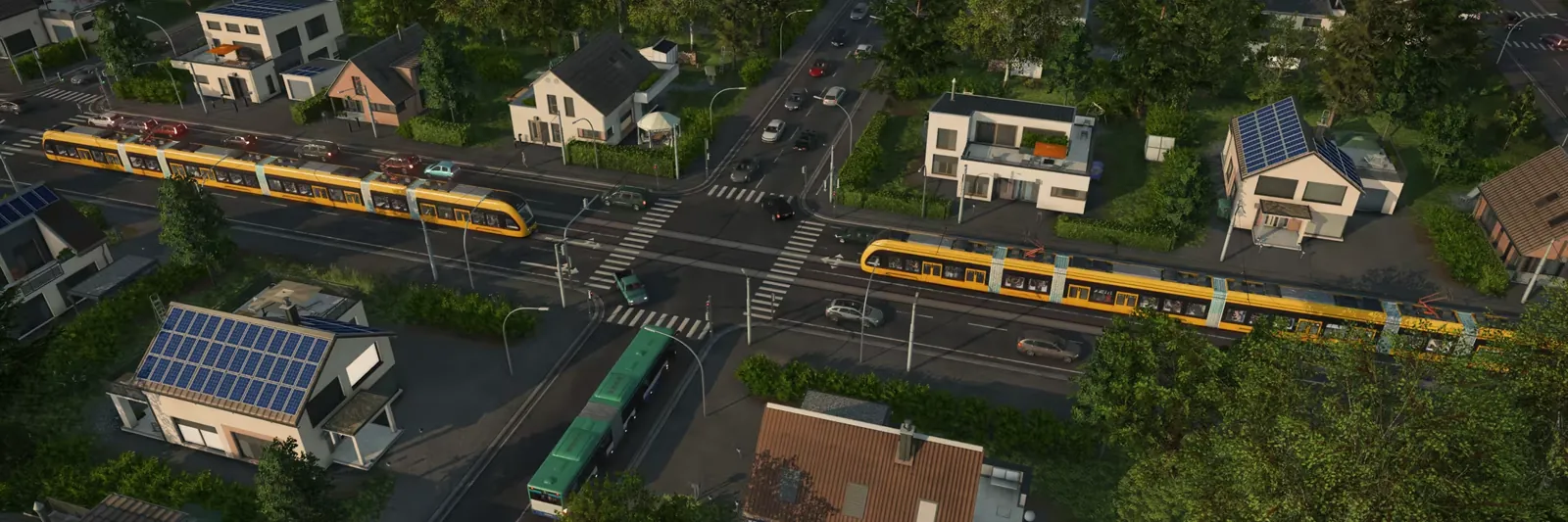
Why Cargo Trams Exist
Dense cities punish truck freight. Road convoys bring noise and pollution exactly where town growth is most sensitive to both, and the new tycoon systems make that sensitivity bite harder than in earlier games. Preview coverage of the campaign describes the idea plainly: cargo trams echo the Eastern European practice of bringing goods into city centers by rail instead of noisy, smelly trucks, and TF3 turns that history into a vehicle category.
Official source: Transport Fever 3 Industries and Cargo Revealed
The Steam store page lists dedicated cargo trams alongside light rail systems as covered transport types, which confirms both as first-class systems rather than reskins.
Official source: Pre-purchase Transport Fever 3 on Steam
Think of cargo trams as the last-mile answer: heavy trains do the long haul to a city-edge terminal, and cargo trams do the final kilometers to shops and factories on rails the city tolerates better than truck routes.
Cargo Trams vs Light Rail vs Street Trams
Three rail-ish systems now overlap in and around cities, and mixing them up leads to bad building decisions. The table separates them by confirmed role.
| System | Job | Key Trait |
|---|---|---|
| Classic street trams | Local passenger distribution | Runs on streets, stop spacing is tight |
| Cargo trams | Last-mile urban freight | Configured like trains, runs on tram track |
| Light rail | Fast suburb-to-center passenger links | Dedicated system beyond classic tram scope |
The critical sentence comes from the official infrastructure dev blog: with the introduction of cargo trams, trams are now configurable in a way similar to trains, and tram lines can extend beyond city limits. That single change kills the old assumption that trams stay inside town borders.
Official source: Dev Blog Episode 3: Infrastructure
Overland trams, simplified road and rail construction, and dedicated tram lanes with configurable road connections all arrive in the same package. The practical read: plan tram corridors as real rail-lite infrastructure with depots, termini, and dedicated lanes, not as cosmetic street loops.
Where Cargo Trams Fit in a Freight Chain
Cargo trams do not replace line-haul trains or trucks. They replace the final truck leg that used to drive straight into the growth-sensitive town center. A sensible chain looks like this: mine or farm to a city-edge terminal by train, terminal storage in a warehouse, then cargo tram distribution to inner-city commercial and industrial buildings.
Warehouses and dedicated terminals with transshipment storage are confirmed systems, and they are the natural handoff point between heavy rail and cargo trams. Until capacities are known, size the tram leg generously: running two smaller tram consists beats one overloaded line that starves shops during growth pushes. The full category context sits in the vehicles overview, and the rail half of the handoff follows the same layout logic as the train signal upgrade path.
Keep cargo trams short. Every kilometer of tram track inside a city is track trucks cannot congest and residents tolerate better. Long cross-map tram hauls waste the speed advantage that belongs to real trains.
One open question is stop spacing. Community discussion around light rail suggests keeping several hundred meters between stops for faster systems, but that is player theorycrafting from previews, not a confirmed rule. Mark it as pending launch verification and test both spacings on your first city.
Building Your First Cargo Tram Line
Start with one producing industry connection that already works by truck, so demand is proven before you spend on rails. Lay dedicated tram track from a terminal near the town edge to the commercial district, configure the consist the way you would a short train, and run a single cargo tram first. If shops start receiving goods reliably, add consists until the line saturates, then consider whether the town even needs its old truck route anymore.
Watch the town response, not just the cargo numbers. The payoff of cargo trams is quieter, cleaner streets that keep growth ratings healthy while freight still flows. If the timetable and day-night systems allow off-peak scheduling at launch, night-shifted freight trams could stack a second advantage on top, but that combination is still pending launch verification.
Nobody has published cargo tram running costs, capacities, or availability years. Do not demolish a working truck network to fund trams before you can compare the numbers in the release build. Build the tram line as an addition first, and only retire trucks once the math checks out.
Underground and elevated construction options exist for rail in TF3, and noise barriers plus tree-lined streets are confirmed mitigation tools, so a tram corridor that still annoys residents has further answers available. Those tools cost money, which is another reason to prove the line earns before upgrading it.
Frequently Asked Questions
What is a cargo tram in Transport Fever 3?
A freight vehicle that runs on tram track, new to the series. It is meant to deliver goods into city centers without the noise and pollution of truck convoys, and it configures like a train rather than a classic street tram.
How are cargo trams different from light rail?
Cargo trams carry freight on tram tracks into dense districts. Light rail is a separate, faster passenger system for longer suburb-to-center links. Both are confirmed on the Steam store page as covered transport types.
Can trams leave the city in Transport Fever 3?
Yes. The official infrastructure dev blog confirms trams are now configurable like trains and can extend beyond city limits, alongside overland trams and dedicated tram lanes.
Should cargo trams replace trucks completely?
Not as a blind rule. They replace the last-mile urban leg where noise and pollution hurt town growth. Long-haul freight still belongs to trains, and rural deliveries still belong to trucks. Exact cost comparisons are pending launch verification.
When will real cargo tram stats be available?
After the September 29 launch, once players can read capacity, speed, cost, and availability years in the game depot. Treat every pre-launch numbers table as speculation.
More Transport Fever 3 Guides
Helicopters are new in Transport Fever 3, with the Sikorsky S-76 confirmed. What they are good for, what they cannot do, and costs still unconfirmed.
How money works in Transport Fever 3: delivery income, running costs, full loads, and the route habits that turn thin lines profitable.
Transport Fever 3 landmarks grant area bonuses tied to headquarters and company rank. Confirmed landmarks, how bonuses work, and subsidy details still pending.
Transport Fever 3 loans and contracts explained: dynamic borrowing, risk-versus-reward deals, and rules for debt that builds instead of kills.
Transport Fever 3 mods run through an in-game browser with cross-platform support. Learn Curated Mods, mod.io, and Workshop status.
Cut noise and pollution in Transport Fever 3: barriers, trees, underground rail and fleet maintenance. Pre-launch guide.
Transport Fever 3 offshore oil and fishing guide: rigs, fishing grounds, ships and climate limits for sea supply chains. Pre-launch.
Fix Transport Fever 3 lag and stutter: graphics settings that help, CPU bottleneck advice, and late-game slowdown cures that work.