
Air in Transport Fever 3: 30 base aircraft from 1920, multi-purpose airports, passenger money by speed, freight money by cargo complexity.
Transport Fever 3 Airport: Planes, Runways, and Your First Air Route
Quick answer: aircraft arrive in 1920, the airport is a multi-purpose construction rather than a bare runway, and the two kinds of air traffic pay under two different rules. Passenger fares reward long distance flown fast, which is air transport's natural home. Freight pays for cargo complexity, not distance, and every good has a delivery window, so a cheap slow boat can beat a fast expensive plane on bulk stone. No official TF3 runway or gate counts exist yet, so any second-runway plan carried over from Transport Fever 2 is speculation.
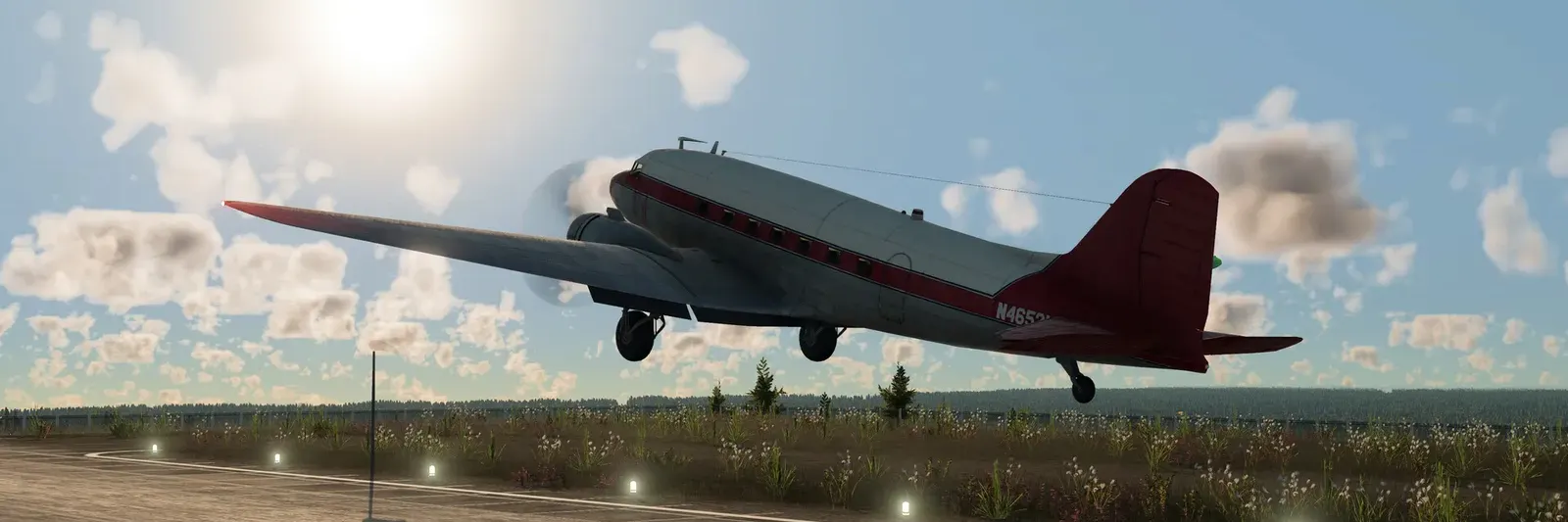
The Air Roster: 30 Base Aircraft, 11 Helicopters
The store page lists aircraft and helicopters as two vehicle types inside the 275+ roster. That figure is the store's own, not a settled total: the official editions page says more than 300 vehicles instead, and no per-model stat sheet is published either way. The line-by-line figures below therefore come from a community vehicle table transcribed from the launch depot. Community-observed; it may change with patches.
Official source: Pre-purchase Transport Fever 3 on Steam
That table's 30 base aircraft span 1920 to 2013 and 11 helicopters span 1950 to 2030. Of the 30, 16 are passenger-only, 11 freighters, and 3 combi, so roughly 41 of its 285 entries are air vehicles. Capacity is reproduced as the table gives it, a bare number with no unit.
| Aircraft milestone | Year | Top speed | Capacity as listed | Cargo type |
|---|---|---|---|---|
| Junkers F 13 Herta | 1920 | 135 km/h | 16 | Passengers |
| Curtiss C-46 Commando | 1942 | 280 km/h | 80 | Universal |
| Convair CV 990 Coronado | 1962 | 917 km/h | 200 | Passengers |
| Lockheed L-100 Hercules | 1976 | 400 km/h | 43 | Universal |
| DC-10-30CF Airliner | 1978 | 960 km/h | 400 | Passengers |
| DC-10-30CF Freighter | 1978 | 960 km/h | 133 | Universal |
| Boeing 737-700 | 1998 | 974 km/h | 200 | Passengers |
| Airbus Canada A220 | 2013 | 830 km/h | 180 | Passengers |
The trend is capacity, not speed: 16 in 1920, 400 by 1978.
It lists names, years, speeds, capacities, and cargo types, nothing else. Purchase price, running cost, lifespan, and per-aircraft noise and pollution ratings are missing for every airframe, and three helicopters share an identical 610 km/h figure that reads as a placeholder. Confirm every number in the depot before spending.
The Airport Building: Multi-Purpose Modules and Unconfirmed Runways
Episode 2 states the TF3 change directly: what airports could already do in Transport Fever 2 is extended much further through multi-purpose constructions, named as airports with integrated hangars, industries with built-in truck docks, and harbors combining ship piers with helipads.
Official source: Dev Blog Episode 2: Industries and Cargo
Practically, an airport is a facility you compose, not a strip you drop. A hangar beside the apron, a road connection feeding the terminal, and a helipad for rotorcraft are parts of the same construction. The same system lets a harbor absorb a helipad, so a mixed harbor can serve as your offshore and light-freight terminal without a fixed-wing field. That hub logic is in the warehouses and terminals guide.
Runways and gates are the open question, and the most-searched corner of the older airport question set. The unlock year is settled: the official Known Issues page lists a console softlock from opening empty construction menus and names the cause as the Plane menu pre-1920, which fixes first aircraft at 1920 and matches the earliest year in the community roster.
Official source: Transport Fever 3 Known Issues
Counts and orientation are not. A player on the official Episode 2 thread reported that in Transport Fever 2 one airport held 8 to 10 aircraft, was capped at two identical runways, and offered no way to vary runway direction or terminal position, then asked whether TF3 changed any of it. No developer answer appears in the thread. Community-observed; it may change with patches, and it describes the previous game. One developer position on scale appeared in a 1 August 2026 reply in the Episode 5 comment thread: TF3 airports are, for the sake of gameplay, significantly smaller than reality because the game operates on an abstract level, with all-new models on a similar scale to previous games. That reply did not render on a repeat fetch of the thread on 30 September 2026, so treat the wording as unverified against the live page.
TF3 runway counts, gate counts, and orientation rules are unconfirmed. Build one well-placed airport, count how many aircraft it holds before a departure queue forms, and only then consider a second field.
Passenger Money and Freight Money Are Two Different Systems
Developer Sam answered a player on the Episode 4 thread: the distant cargo route method from Transport Fever 2 is a thing of the past, long-distance passenger travel at speed will continue to pay well, but for goods it is the complexity of the cargo delivered that matters far more to payment.
Official source: Dev Blog Episode 4: Tycoon
Freight also carries a clock the passenger side does not. The Delivery rating gives all goods an expected time, food being time-critical and bulk stone tolerant, and late goods still generate revenue but cost city rating. The blog then makes the air-versus-sea call: for tolerant bulk, expensive fast airplanes may not be necessary, and the slower sea route is more economical.
| Question | Passenger air | Air freight |
|---|---|---|
| What drives payment | Distance flown at speed | Complexity of the cargo |
| Time limit | No delivery window | Expected delivery time per good |
| Late arrival | Not applicable | Still pays, city rating falls |
| Official steer | Long and fast keeps paying | Fast planes often uneconomic for bulk |
| Best fit | Two large towns, no rail link | High-complexity goods across water or mountains |
| Main risk | Airport cost and noise | Missing a window on food or parts |
Read the columns as two businesses. The passenger case is a monopoly on a corridor nothing else serves cheaply. The freight case is a service contract on one valuable good, competing against ships rather than airlines. Stone, aggregate, and other low-chain bulk belongs on a boat. The cargo payment breakdown covers the formula, and the production chain overview shows which goods sit high enough in complexity to be worth flying.
Air freight earns on complexity, so take finished goods at the end of a long chain, or anything crossing open water or a mountain barrier where the alternative is a detour. Leave raw bulk to ships, where the window is forgiving.
Where the Noise and Pollution Land
On the municipal area, not the airport tile. Episode 4 states that the world is divided into municipal areas around each city, that these drive mechanics through bonuses and negative impacts such as pollution, and that pollution from industries, infrastructure, and vehicles is recorded across the entire municipal area so you cannot build around the city to escape it.
Official source: Dev Blog Episode 4: Tycoon
Two consequences. Siting outranks equipment: a hub inside a municipal area taxes that city, and the only real avoidance is placing it outside the region, not merely outside the built-up blocks. And airports are named twice in the blog as a problem. Noise is framed as a choice between a short route to a noisy station and a large hub on the outskirts feeding quiet local buses and trams. Reputation is framed with an airport as the build that angers residents when a forest is cleared or a great deal of earth moved.
No emission radius, noise weighting, or per-aircraft figure is confirmed. The mitigation toolkit is in the noise and pollution guide.
Why Helicopters Do Not Replace Fixed-Wing
The arithmetic settles it. Eleven helicopters against 30 aircraft, and no rotorcraft entry approaches the 400-capacity DC-10-30CF Airliner or the 133-capacity freighter. The largest listed rotor freighters are the MIL MI-26TC at 120 from 1993 and the Chinook at 80 from 1980, and the top helicopter speed figure is the same suspect 610 km/h that appears three times. The Sikorsky S-76 Spirit, the Deluxe rotorcraft, is listed at 40 and 287 km/h from 1977, a commuter link rather than a trunk line.
Passenger revenue tracks distance flown at speed, and only the fixed-wing roster covers 850 to 974 km/h at volume. Helicopters are terrain tools, and the launch build wires them into harbors rather than runways, since multi-purpose constructions can pair piers with helipads. The helicopters guide covers that class in full, and the vehicles list puts the air roster in context.
When to open your first air route
| Check | Pass when |
|---|---|
| Calendar | 1920 has arrived and the plane menu is no longer empty |
| Demand | Both ends have a real source: two passenger towns, or a producer and consumer of a high-complexity good |
| Alternative | No cheaper mode does the same job; if rail already connects the pair, a plane is redundant unless the distance is rail-hostile |
| Siting | The field sits outside the municipal areas whose growth you care about, or the noise cost is deliberate |
| Data | You have read the depot page for that airframe, including running cost, which no public table has |
| Scale | One round trip is measured against the boat or train on the same pair before buying a fleet |
Frequently Asked Questions
When do planes unlock in Transport Fever 3?
- The official Known Issues page names an empty Plane construction menu before 1920 as the cause of a console softlock, and the earliest aircraft in the community roster is the 1920 Junkers F 13 Herta.
Can I build more than one runway at an airport?
Not yet confirmed. No official TF3 figure exists for runway or gate counts, and a player asking exactly this on the Episode 2 blog thread received no developer answer. Transport Fever 2 was reported there as capped at two identical runways, but that describes the previous game.
Why does my air freight earn less than my passenger flights?
Different rules, on purpose. Freight payment tracks cargo complexity rather than distance, so hauling stone across the map pays less than a finished good next door. Every good also has a delivery window, and missing it costs city rating even though the delivery pays.
Do airports pollute the town they sit next to?
Yes, and you cannot site your way out of it. Pollution is recorded across the entire municipal area, and Episode 4 names airport construction specifically as something that angers residents when it clears forest or moves earth. Push the field outside the municipal area, not just outside the houses.
Can helicopters replace planes?
Not for anything distance-critical. The rotor roster is 11 models with no large-capacity class against 30 aircraft including 400- and 133-capacity entries, and passenger revenue rewards distance flown fast. Helicopters are for terrain and for harbors, where multi-purpose constructions pair piers with helipads.
Related Guides
The helicopters guide covers the rotorcraft class, the vehicles list puts the air roster in context, and the noise and pollution guide covers the mitigation side of an airport's municipal-area cost.
More Transport Fever 3 Guides
How Transport Fever 3 pays for cargo: distance, speed, complexity, and on-time delivery windows that decide profit per load.
Transport Fever 3 city growth explained: 18 levels, XP, six ratings and hamlet-to-metropolis planning. Pre-launch guide.
TF3 hit PS5 and Xbox Series X|S on September 29, 2026 alongside PC: console prices, Game Pass status, save transfer, and why Xbox search fails.
Survive Transport Fever 3 hard mode: strict openers, loan discipline, and cashflow rules that keep a brutal start from ending early.
Helicopters are new in Transport Fever 3, with the Sikorsky S-76 confirmed. What they are good for, what they cannot do, and costs still unconfirmed.
How money works in Transport Fever 3: delivery income, running costs, full loads, and the route habits that turn thin lines profitable.
Transport Fever 3 industries: the density setting is a map slider, no closure timer is confirmed, and boosters replace TF2 density targets.
Transport Fever 3 landmarks grant area bonuses tied to headquarters and company rank. Confirmed landmarks, how bonuses work, and subsidy details still pending.