
Transport Fever 3 industries: the density setting is a map slider, no closure timer is confirmed, and boosters replace TF2 density targets.
Transport Fever 3 Industries: Density Settings, Boosters and Closures
Quick answer: Transport Fever 3 has no confirmed per-industry density target slider like the one Transport Fever 2 put in every industry panel, and no documented timer that closes an industry when it runs dry. The density control that does exist sits in the map editor and sets how many industries world generation starts you with. Output beyond that stock comes from boosters, and Episode 2 gives the reason: they "allow increased output even with few industries connected." A starving factory does not close; the rating that falls is the town's, and the industry stops being worth feeding.
Two corrections worth reading first:
- Density is a world-generation setting, not a per-industry slider. A launch-day seed-sharing post shows it in the map editor as its own control, separate from town density, with the author setting industry density to Medium and town density to Dense. Community-observed; it may change with patches.
- Closure is not a confirmed mechanic. No official text describes industries shutting their doors on a timer. The one hard zero here is town reputation: the achievement It Wasn't Me asks you to reach 0% in Free Game, and only 9.8% of players have.
Density in TF3: what the setting is, and why it looks broken
Episode 2 explains the start condition instead of a slider: towns begin by demanding simple cargo such as fish, vegetables, or planks, and "only the required industries exist on the map." The industries behind multi-stage products "appear dynamically on the map as demand arises." So your industry count is a function of what your towns want, not a target you dial in.
Official source: Dev Blog Episode 2: Industries and Cargo
That makes the map editor's industry density a starting condition, not a cap, and launch-day players reported the gap between label and result. A bug report in the official Urban Games support forum, posted the evening of release, reads: "Industry placement is inconsistent and apparently unaffected by the slider. Highest density only increases the number of industries if you lower the number of towns available." The same poster added: "Packed industry sometimes gives high 20's, mostly just gives ~20, the same as the normal setting."
Official source: Urban Games forum: Map Generation does not conform to sliders
A reply quoted later in the thread argues the design is deliberate: "Not all the industries are there right from the start. Maxing out the Industries according to your set amount would result in you having wayyy to many starting industries (the simpler ones) and then no capacity for future demands in your cities." Community-observed; the poster's role is not verifiable, so read it as a player interpreting the design. The same thread explains the mandatory water: fishing grounds and sand sit offshore, so "You need some water for Fish and Sand, although maybe try to play around with the seed some more."
Community-observed; it may change with patches. If your plan assumes a tight cluster of processors near one town, generate the map, count what you actually got, and build around that.
Closures: no timer, but a production level and a reputation zero
There is no published closure condition, threshold, or frequency. If a source tells you an industry shuts after N months of no deliveries, treat it as unverified: nothing on the official game page or the Episode 2 and Episode 4 posts describes it.
What does exist is a failure chain mistaken for a closure, and it runs town-side first. Towns climb through 18 growth levels, from hamlets of fewer than 100 inhabitants to metropolises, and experience points come from moving passengers and supplying required goods. Each town keeps six ratings, named in Episode 4: Reputation, Satisfaction, Delivery, Traffic, Noise, and Pollution.
Official source: Dev Blog Episode 4: Tycoon
Those ratings do not switch an industry off, but they throttle everything downstream: "Low values in these ratings limit the growth factor, reducing the effectiveness of collected experience points." A capped town stops demanding more volume, and the factory that only existed to feed its growth tier has nowhere to sell. That is the mid-game collapse players report, and it is a demand problem, not a closure rule.
| What you see | What it actually is | What to change first |
|---|---|---|
| Output piles up, tankers leave half empty | Production above haulage capacity | Vehicles or wagon length at pickup, not a second plant |
| Town buys slowly, Delivery rating falls | Per-cargo deadlines, not distance | Load time: extra station in the catchment, or a module |
| A branch goes quiet after a town levels up | New upstream industry spawned, unconnected | Toggle the cargo flow overlay, find the plant |
| New plant is nowhere near your line | Demand-driven placement | Extend the line, or price the distance in |
| Fishery refuses to build in a desert | Industries adapt to climate zones | Reroll the seed, or build the land chain |
| Density set to Packed, still roughly 20 industries | D+1 reports the slider barely moves it | Change the seed; treat the slider as a starting bias |
| Reputation at 0% and deliveries stop | The documented zero in this system | Cut pollution and noise around that town |
The official known-issues page lists a console-only softlock when opening empty construction menus, and names several industries in sandbox mode as a trigger. The listed workaround is to save and load again. If your industry panel freezes on PlayStation or Xbox, that is this, not a broken save.
Which booster to fix first
Boosters are the only documented lever that raises output per industry, and Episode 2 is explicit that they exist because of the low factory count: workers "allow[s] increased output even with few industries connected." The set is small, so priority order is the real decision.
| Booster | Accepted by | Buy it when |
|---|---|---|
| Workers | Any industry falling behind demand | The chain works but the factory is the constraint |
| Fertilizer | Farms | A farm cannot keep a cannery supplied on its own |
| Tools | Mines | Ore or stone output is below what the next link eats |
| Machine parts | Mines | A high-tier mine is capped and you have capital to spare |
Order of operations: workers first, because they apply everywhere and need no chain of their own. Fertilizer and tools come next, only for the industry that is visibly the bottleneck. Machine parts are last, since they cost a whole upstream chain and only pay off on high-tier mines.
Two constraints keep this honest. Boosters add infrastructure and traffic, so a boosted farm on a one-truck dirt road just moves the bottleneck to the loading dock. And the store page puts demand first — "Demand-driven industry expansion with production boosted by workers and optional inputs" — so boosting an industry whose customer is a stalled town spends money to fill a warehouse. The achievement Boost the Pack, which needs boosters on 10 industries at once, sits at 0.4% globally.
Cargo flow can be displayed directly over industries and their transport facilities, and the store page pitches data layers for finding delivery problems. Two minutes with the overlay tells you which plant is the constraint.
How town ratings starve the chain, and where it breaks
The chain rarely breaks at the strongest industry. It breaks at the link feeding the town, the only node whose behaviour is measured. Three of the six ratings reach a production chain directly. Delivery is per cargo type and time-sensitive, so food is fairly time-critical while bulk goods like stone tolerate a slow trip; miss the window and the load still pays, but the rating falls, the growth factor caps, and the volume increase you built that plant for never arrives. Pollution counts industry, infrastructure and vehicles across the whole municipal area, so siting a boosted plant just outside the boundary is not the dodge it looks like. Traffic compounds both, since a congested last mile stacks on every deadline.
Payment behavior is in Cargo Payment Explained, the town flywheel in City Growth Explained. When a supplier's pollution is what caps the town it feeds, no freight reorganization fixes it — you move the supplier, and the production chains overview covers how that reshuffles the route.
32, 35-plus, or 30-plus: which industry count to trust
The official numbers disagree with each other, which is worth stating plainly rather than picking a winner.
| Figure | Source | Wording |
|---|---|---|
| 35+ | Steam store page and official game page | Over 35 unique industries, including off-shore sectors |
| 32 | August 2025 official press release | 32 industry types and 37 cargo types, double TF2 |
| 30+ | The official editions page | Over 30 onshore and offshore industries |
Official source: Transport Fever 3 editions
Two of those three are first-party, so preferring official sources does not resolve it, and neither number was re-confirmed at launch. The editions page cannot simply be dismissed as older copy either, because it disagrees in the opposite direction on vehicles: it says "more than 300 vehicles" where the game page says "275+ realistic vehicles". One page is not simply staler than the other. Use 35+ for a headline number and treat the exact industry list as not yet confirmed.
The cargo side is not in dispute: 37 cargo types in four handling categories, from Episode 2.
Vehicle counts are at least resolvable, and they resolve the other way. Three first-party sources say 300+ — the editions page, the official support FAQ ("using more than 300 vehicles across over 120+ years of transport history"), and the First Look Episode 5 launch post — while 275+ survives only on the game page and the Steam store. So 275+ reads as leftover pre-launch marketing, and the Vehicles List is the better-numbered reference. That asymmetry is the honest summary: vehicles have a current figure, industries do not.
Official source: Transport Fever 3 support FAQ
Frequently Asked Questions
Where do I set the industry density target in Transport Fever 3?
You probably cannot, and that is not a settings problem on your end. No official TF3 text names a per-industry density target control, and the launch-build industry panel has not been confirmed to carry TF2's slider. The density setting that does exist is in the map editor, shaping world generation rather than an individual plant.
Do industries close when they stop selling?
No closure timer has been confirmed, and no official source states a trigger, a threshold, or a frequency. What is documented runs the other way: town reputation can fall to 0%, and low ratings cap the growth factor, quietly reducing the demand your industry was built for.
My industry produces but the stockpile keeps growing. What do I change?
Haulage, not production. Add vehicles or wagon capacity at the pickup, and if the queue is at the loading dock, build an extra station inside the industry's catchment area or fit a specialized module. A universal loading station is cheapest and cleanest but slowest.
Should I boost every industry at once?
No. Workers are the general-purpose booster and the right first purchase, but fertilizer only helps farms and tools or machine parts only help mines. Boost the plant that is measurably the constraint, and remember the extra output still has to leave the gate on a line that can carry it.
Does the industry density slider actually work?
Launch-day reports say it barely changes the count, with the highest setting often producing roughly the same number of industries as the default. That is community-observed and may change with patches. The seed is the reliable dial, and fewer towns on the map is the other lever.
My industry will not build in this region. Is that a bug?
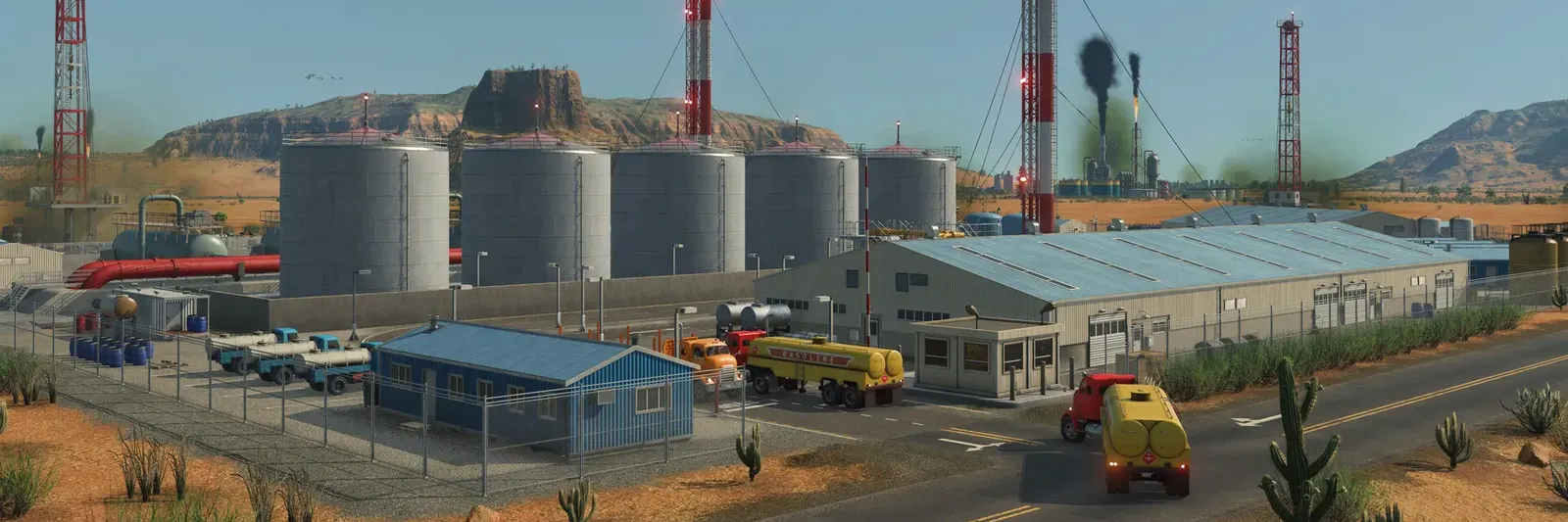
Probably not. Industries adapt to climate zones, so there are no fisheries in deserts. The desert refinery in the header image shows what a dry region does support, and the water side is covered in Offshore Oil and Fishing Guide.
Related Guides
- Production Chains Overview — the 37 cargo types and four handling categories that decide which vehicle can reach your industry.
- City Growth Explained — the 18 growth levels behind every demand calculation.
- Offshore Oil and Fishing Guide — the forced water on every map, and the chains on it.
- Cargo Payment Explained — how late deliveries still pay while costing you the town rating.
More Transport Fever 3 Guides
Transport Fever 3 cargo stuck at the station? Demand, catchment, line setup and deadline checklist to get freight moving. Pre-launch.
How Transport Fever 3 pays for cargo: distance, speed, complexity, and on-time delivery windows that decide profit per load.
Transport Fever 3 city growth explained: 18 levels, XP, six ratings and hamlet-to-metropolis planning. Pre-launch guide.
TF3 hit PS5 and Xbox Series X|S on September 29, 2026 alongside PC: console prices, Game Pass status, save transfer, and why Xbox search fails.
Survive Transport Fever 3 hard mode: strict openers, loan discipline, and cashflow rules that keep a brutal start from ending early.
Helicopters are new in Transport Fever 3, with the Sikorsky S-76 confirmed. What they are good for, what they cannot do, and costs still unconfirmed.
How money works in Transport Fever 3: delivery income, running costs, full loads, and the route habits that turn thin lines profitable.
Transport Fever 3 landmarks grant area bonuses tied to headquarters and company rank. Confirmed landmarks, how bonuses work, and subsidy details still pending.