Transport Fever 3 truck stations: where the catchment really is, the three loading tiers, station length for simultaneous loading, and route shapes.
Transport Fever 3 Truck Stations and the Full Trucking Loop
Quick answer: a truck station's usefulness comes down to two things Urban Games has described but never numbered - whether it sits inside the industry's catchment, and how many vehicles its length lets load at once. Episode 2 of the dev blog: truck stations now let multiple vehicles load or unload simultaneously, provided the station is long enough.
Where a Truck Station Has to Sit
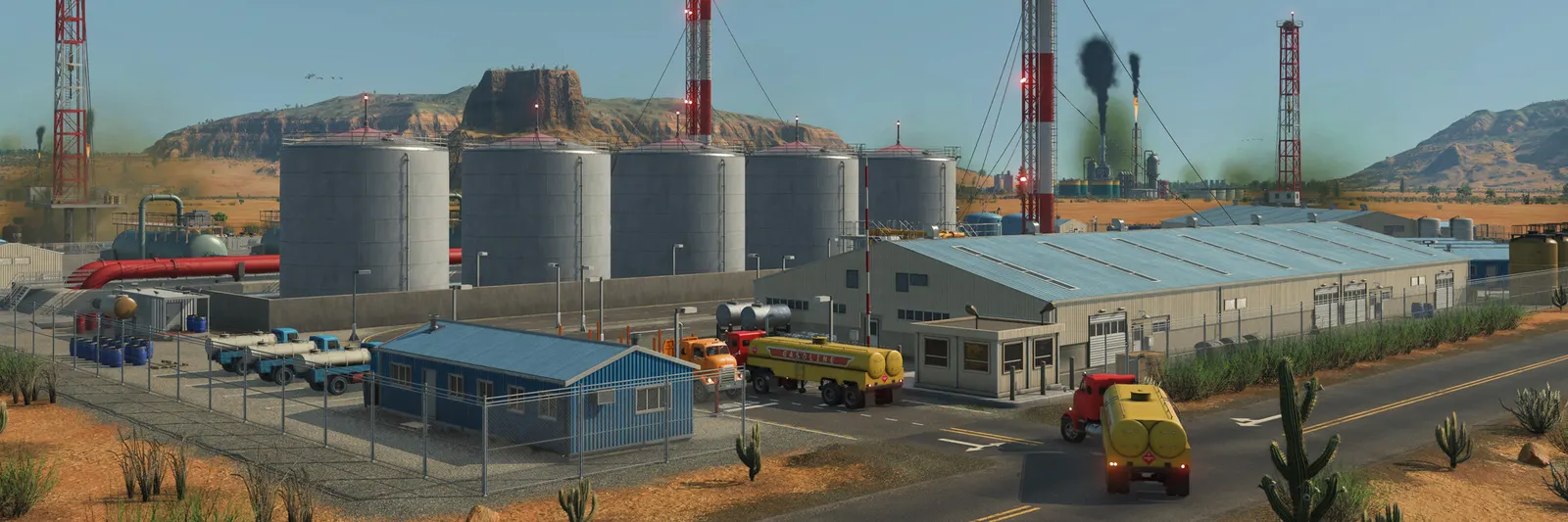
The official pickup-speed rule is short: build additional stations inside an industry's catchment area to load faster. That reach is not published for TF3, and there is no radius to look up.
Official source: Dev Blog Episode 2: Industries and Cargo - "players can build additional stations within an industry's catchment area."
The previous game's manual kills the most common misconception here: there is no circular radius. Reach is measured along the streets, so a building 100 metres away as the crow flies can be out of reach if the road loops.
Official source: Stations and Depots - Transport Fever 2 Wiki - "The catchment range is calculated by the distance along the streets, not by a circular radius from the station." Every building inside the catchment highlights in white when selected.
That is TF2 documentation, so verify reach in-game by selecting a station and watching what highlights.
| Placement choice | What it buys | What it costs |
|---|---|---|
| Built-in industry dock | Zero construction | Slowest; queues first |
| One universal station in the catchment | Faster, cheap, cargo-flexible | Slowest of the three platforms |
| Universal platform, lengthened | More vehicles at once | Road frontage, upkeep |
| Specialized platform, one category | Fastest for that category | Refuses other cargo; costlier, noisier |
Select the station and check which buildings turn white. If your industry is not among them, no length will make it work. This is the most common cause of a truck line that never moves a load.
Loading Tiers, Platform Length, and What Each Costs You
Three ways of getting cargo onto a vehicle exist, and the dev blog ranks them without a multiplier. Integrated industry docks are "slower than any of the alternatives". A universal loading station is "the most basic option and is the slowest", but wins on cost and flexibility. Specialized platforms "give you maximum speed", refuse other cargo, and raise bills plus pollution and noise.
Official source: Dev Blog Episode 2: Industries and Cargo - "A universal loading station is the most basic option and is the slowest."
So no number exists to quote, and any guide claiming the station loads at 4x is inventing it. Read the real figure in the purchase menu.
Official source: Dev Blog Episode 5: Highlights - the purchase menu was overhauled with in-menu comparison of loading speed, comfort, noise and pollution.
On public data, be skeptical. The most detailed community vehicle table for TF3 lists 285 vehicles and gives a numeric loading speed for only 10, two of them trucks and both horse-drawn. No motorised truck in it has a figure. Any rate you read elsewhere is community-observed; it may change with patches.
The same blog answers trucks not fully unloading: "Truck stations also now allow multiple vehicles to load or unload simultaneously at the same time, provided the station is long enough." In TF2 a queue crawled through one truck at a time no matter how many waited; in TF3 the constraint moved to the platform's length, a construction problem you can solve. The TF2 manual shows the shape of that fix - up to six platforms, extended by 10-metre modules - but the TF3 truck count per length is not yet confirmed.
If six trucks are assigned and three load while three wait in the street, the fix is a longer platform or a second station in the catchment. A bigger truck makes it worse.
Why Trucks Leave Half Empty
A fast station still produces part-empty departures when the vehicle count is wrong, or a junction blocks one truck. The redesigned Line Manager shows you why: lines, stations and vehicles can be edited in the game world.
| What you see | Real cause | Fix |
|---|---|---|
| Part-loaded departures, no queue | More vehicles than the line can fill | Sell one back; add only when the stockpile grows |
| Full trucks queue at the origin | Loading throughput is the bottleneck | Second station in the catchment, or a longer platform |
| Part-loaded arrivals, small town | Town tier too low for that cargo | Check demand before adding capacity |
| Trucks arrive and drive straight on | Cargo category mismatch | Match tanker, bulk, stake and box bodies |
On load factor, be precise: the game publishes no target percentage, and no truck refuses to depart below a threshold. Any specific figure you see quoted is a community yardstick, not a rule, and it may change with patches. A truck that never once leaves visibly part-loaded is doing its job; a consistent empty return trip means too many vehicles. The money guide covers the arithmetic.
A developer confirmed on the official forum at launch: "You can only unload cargo if it has a destination, so either a factory, an end consumer, or (in this case) a warehouse." A truck reaching a station that cannot receive the load has wasted a trip. See Cargo Not Moving.
Route Shapes: Shuttle, Loop, or Multi-Stop
Three shapes cover most trucking jobs. Which one you want depends less on the map than on whether the return leg has a destination.
| Route shape | Best for | Cost profile | Watch out for |
|---|---|---|---|
| Two-stop shuttle | Producer to one consumer | Lowest infrastructure | Half-empty returns once demand is met |
| Closed loop, several stops | One truck serving many pickups | One vehicle covers a district | Long empty stretches between stops |
| Multi-leg via warehouse | Producer to hub to consumers | Highest cost, best reach | Deadlock when every leg wants the truck |
A shuttle wins early because every problem has one suspect, which is why the beginner first line starts there. Loops win once a district has small industries that cannot individually fill a truck. Multi-leg routes need a warehouse.
One thing assumed to exist and does not: trailer uncoupling, or slinging. No official TF3 source describes dropping a trailer and collecting a loaded one elsewhere. Treat it as not implemented; the substitute is a warehouse handoff with a line on each side.
Sizing is where published data runs out. The community table gives speed and capacity for 48 truck entries, from the 16 km/h Small Horse Carriage to the 120 km/h FAW Jiefang J6P, but cost for two, lifespan for none.
Trucks Versus Trains on the Same Freight
Urban Games has published no side-by-side cost or timing figures. The documentation supports only this:
| Factor | Trucks | Trains |
|---|---|---|
| Entry cost | Road only; no new corridor needed | Track, plus stations and often signalling |
| Short-haul work | Strong; the main reason to use them | Poor; a whole network for one delivery |
| Long-haul work | Works, low capacity per vehicle | Wins on capacity per corridor |
Two hard numbers anchor freight, and they do not measure the same thing. Warehousing Titan needs over 10,000 cargo items in a single warehouse in one Free Game, a usable hub sizing target. Around the World counts 40,075 km of streets and tracks, but Steam words it as combined, so it is a career total across all Free Games, not one map's road network.
Official source: Transport Fever 3 achievements on Steam - both are exact in-game thresholds, as worded on the page.
What the Cargo Redesign Changes for Truck Scheduling
Transport Fever 3 removed the rule that made TF2 freight easy to reason about. Cargo no longer has a destination at production: it sits at its origin until collected, then can go anywhere in your network.
Official source: Dev Blog Episode 2: Industries and Cargo - "Cargo no longer have a destination set when they are first produced... these same cargo now reside at their point of origin until they are collected."
For trucks this inverts the problem. You no longer match a waiting vehicle to a fixed platform; you dispatch capacity to a stockpile that grows at the producer's rate, so the right vehicle count drifts upward as that industry expands. Adding trucks to a growing producer is maintenance, not an exception.
Something usually claimed and not supported: there is no official waiting-at-origin charge. No Urban Games text describes a per-unit fee for cargo sitting at the producer. What is official is the delivery deadline - "newly introduced delivery deadlines for different cargo types make short loading times potentially decisive" - and end customers get unhappy while cargo waits. That deadline is the pressure on your schedule.
Because deadlines are per cargo type, a dedicated express truck is real strategy on perishables and waste on ore. Cargo falls into four categories - liquid, bulk, flatbed and goods - and specialized vehicles handle only their own, per the production chains overview and cargo payment guide.
No TF3 catchment radius, no station loading-rate multiplier, and no truck count per platform length are published officially. The street-distance reach rule above is TF2 documentation carried forward as a prior. The official known-issues page lists three launch entries, all about console saves and a controller softlock.
Frequently Asked Questions
How far does a truck station reach? My trucks will not pick up from the factory right next to it.
Select the station and look at which buildings highlight. In the previous game, reach was measured along the streets rather than as a circle, so a winding road can put a building out of reach even when it looks adjacent. TF3 publishes no figure of its own.
My truck station says it is overloaded and I am losing cargo. What now?
Overloading is not a hard failure. The previous game's manual states stations can be overloaded to a point, but that hurts town growth and loses you cargo. Add capacity inside the catchment, or route the overflow elsewhere.
My trucks do not fully unload and then drive off half full. Is that a bug?
Almost certainly not. TF3 lets several trucks load or unload at once if the station is long enough, so a queue with one truck servicing it is a length problem. Lengthen the platform or add a station, and leave vehicle speed alone.
Should I run one truck shuttling back and forth, or a loop with several stops?
Start with the shuttle. One pickup and one drop-off means every problem has one suspect and profit is easy to read. Switch to a loop once a district has small industries that cannot fill a truck, and add a warehouse leg only to reach consumers no single destination serves.
Do I still need a warehouse if I only run trucks?
Yes, for anything beyond a direct producer-to-consumer line. Stations no longer store cargo, and a truck unloads only where the cargo has a destination - a factory, an end consumer, or a warehouse. Without one you cannot hold freight between legs or split a load across customers.
More Transport Fever 3 Guides
How Transport Fever 3 pays for cargo: distance, speed, complexity, and on-time delivery windows that decide profit per load.
Transport Fever 3 city growth explained: 18 levels, XP, six ratings and hamlet-to-metropolis planning. Pre-launch guide.
TF3 hit PS5 and Xbox Series X|S on September 29, 2026 alongside PC: console prices, Game Pass status, save transfer, and why Xbox search fails.
Survive Transport Fever 3 hard mode: strict openers, loan discipline, and cashflow rules that keep a brutal start from ending early.
Helicopters are new in Transport Fever 3, with the Sikorsky S-76 confirmed. What they are good for, what they cannot do, and costs still unconfirmed.
How money works in Transport Fever 3: delivery income, running costs, full loads, and the route habits that turn thin lines profitable.
Transport Fever 3 industries: the density setting is a map slider, no closure timer is confirmed, and boosters replace TF2 density targets.
Transport Fever 3 landmarks grant area bonuses tied to headquarters and company rank. Confirmed landmarks, how bonuses work, and subsidy details still pending.